

 Language
 Clinical Specialties
Enhanced diagnostic confidence
Prompt and accurate diagnosis becomes paramount when patients present with potential health concerns. POCUS complements physical examinations by concentrating on specific areas of concern, illuminating conditions invisible to the eye. This creates greater confidence in identifying the cause of symptoms. Significantly, Point of Care Ultrasound enriches patient files with crucial data, supplying several clear visuals swiftly to present a detailed analysis for review. This precision streamlines the referral process for appropriate testing or treatment, minimising unnecessary healthcare encounters or redundant imaging procedures.
Time efficiency at the Point of Care
In both emergency and general practice settings, POCUS imagery expedites patient management. Emergency department access to these devices can critically influence patient triage strategies. For instance, real-time information provided by POCUS is invaluable for assessing cardiac symptoms at the bedside. It also facilitates swift decision-making during standard consultations, determining if specialist referral or hospital admission is necessary, thus hastening treatment initiation and alleviating patient anxiety. Beyond in-hospital use, handheld ultrasound such as the portable handheld device Vscan Air SL also proves beneficial in pre-hospital environments. In ambulances and air rescue scenarios, early imaging supports faster diagnosis and targeted care even before arrival at the hospital – maximizing the utility of portable ultrasound at every step of the care pathway.
Minimising diagnosis duration
Frequent POCUS application enhances user proficiency, likely increasing diagnostic accuracy. Advancements in bedside diagnostic speed and efficiency in patient counseling are anticipated. According to a study by the European Journal of Echocardiography, echocardiographic examinations of about four minutes in length – performed by experts with handheld devices at the bedside – provide a reliable assessment of heart structures, pleural space, and major abdominal vessels.

Superior mobile imaging capability
Handheld ultrasound devices enable clinicians to navigate effortlessly around patient environments and create an efficient alternative to other imaging methods. Their portability, compact size, and ease of use make them a preferred choice for many healthcare providers.
Fetal breech presentation with mobile handheld ultrasound
The direct interaction facilitated by POCUS handheld devices allows patients to engage with and understand their diagnostic process better, potentially enhancing trust in medical outcomes.
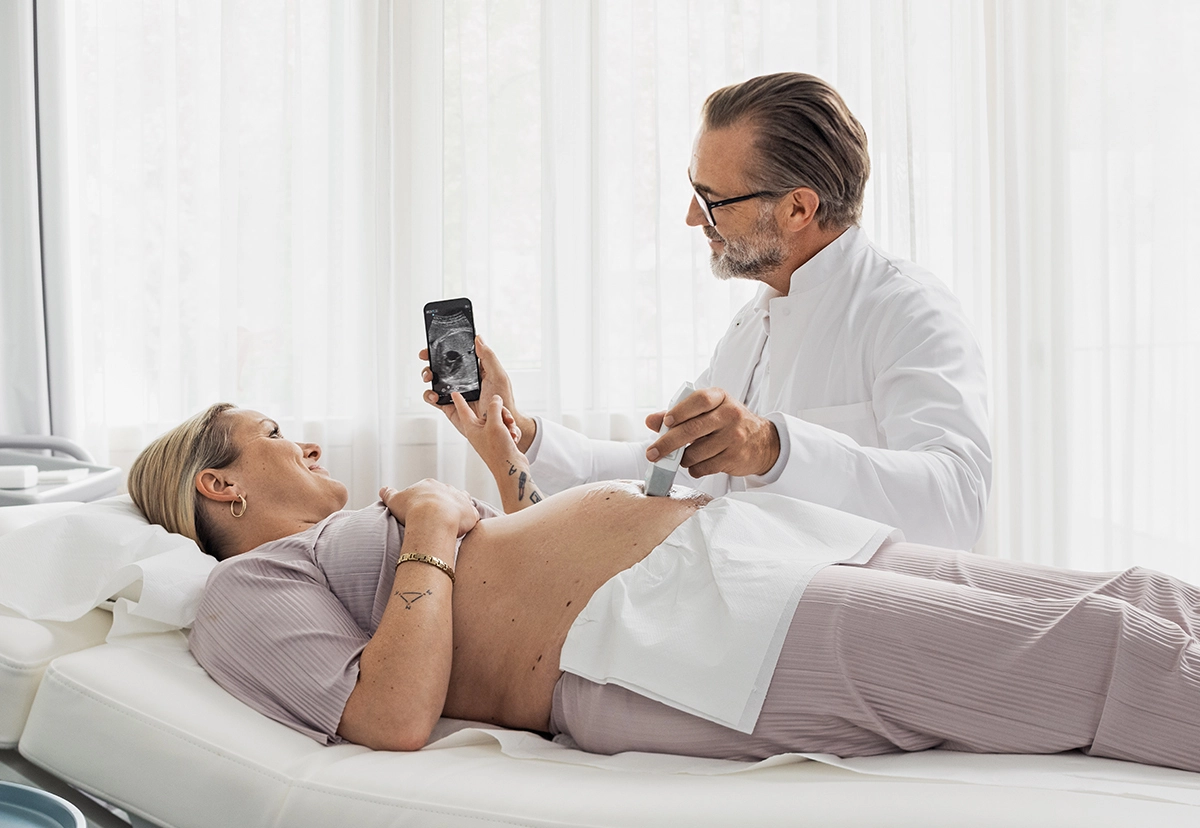
For example, instant visual feedback on an unborn child's health can significantly reassure expectant mothers. This immediate diagnostic capability contributes to higher patient satisfaction rates and potentially shorter hospital stays, aiding early identification of health issues and informed decision-making.
Summary
POCUS stands as a pivotal tool in modern medicine, offering vital insights during physical assessments that expedite diagnosis. The agile capture of images with mobile ultrasound technology markedly surpasses traditional methods in speed, contributing to enhanced diagnostic confidence and overall patient care quality. Handheld ultrasound devices are now ubiquitous, being utilized in various settings such as hospitals, ambulances, and obstetric clinics. This widespread use extends to multiple clinical specialties, including General Practice / Primary Care, Cardiology, Musculoskeletal, Women's Health, Critical Care / Intensive Care, Emergency Medicine, Aesthetic Medicine, and Vascular. Through the identification of potential health issues, medical professionals are empowered to make well-informed treatment decisions, optimizing patient health outcomes.
JB07579XE
Other Topics

Empowering nurses through innovation: Vscan Air™ handheld ultrasound in action at the ICN Congress 2025

A better outlook for mothers in Ethiopia: How Vscan Air™ is transforming maternal care in remote regions

The benefits of handheld ultrasound with AI-based Auto Bladder Volume measurement in everyday clinical practice

Experiences with handheld ultrasound in obstetrics




 Belgium
  Brasil
  Bulgaria
  Croatia
  Czechia
  Denmark
  Deutschland
  España
  Estonia
  Finland
  France
  Greece
  Hungary
  Ireland
  Italia
  Latvia
  Lithuania
  Luxembourg
  Netherlands
  Norway
  Österreich
  Poland
  Portugal
  Romania
  Slovakia
  Slovenia
  Sweden
  Schweiz
  UK
UK 
